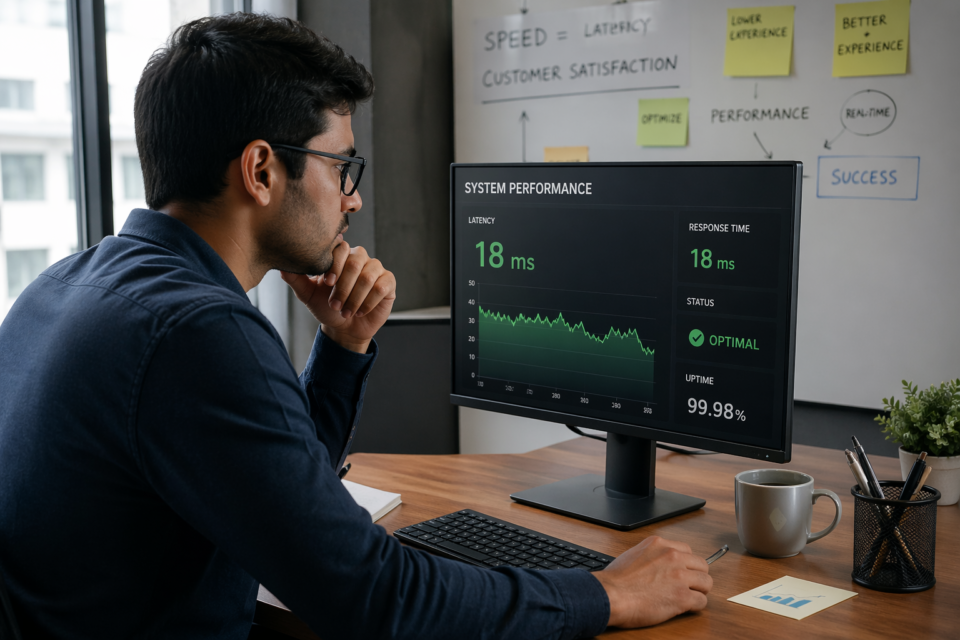
A new competitive battleground is emerging in the digital world—latency. In an era defined by real-time applications, always-on connectivity, and instant user expectations, even milliseconds can influence outcomes. From how quickly a page loads to how fast an AI system responds, speed is now directly tied to performance, engagement, and business value.
This shift is giving rise to what can be called the “Latency Economy,” where response time becomes as critical as the service itself—and often, the deciding factor between success and failure.
What Is the Latency Economy?
The Latency Economy refers to a landscape where the time it takes for systems to respond directly impacts business performance, user satisfaction, and revenue outcomes.
Whether it’s loading a webpage, executing a financial trade, processing AI queries, or delivering content, lower latency translates into:
- Faster and more accurate decision-making
- Seamless and responsive user experiences
- Higher engagement and retention rates
- Increased conversion and revenue potential
In highly competitive environments, the fastest system often wins—not just marginally, but decisively.
Why Latency Matters More Than Ever
Real-Time Expectations
Users now expect near-instant responses. Even slight delays can lead to frustration, drop-offs, and reduced trust in digital platforms.
AI & Data-Driven Systems
Modern applications rely heavily on real-time analytics and AI inference. Latency reduces the effectiveness of these systems and can impact outcomes.
Digital Competition
As products and services become similar in features, speed becomes the key differentiator that sets platforms apart.
Global Scale & Complexity
Distributed systems, global users, and cloud infrastructure introduce latency challenges that require constant optimization.
Where It’s Most Impactful
Finance & Trading
Milliseconds can determine profit or loss in high-frequency trading environments.
E-Commerce
Faster load times directly influence user behavior, conversions, and customer loyalty.
Cloud & SaaS Platforms
Low latency improves productivity, responsiveness, and overall user satisfaction.
Gaming & Streaming
Real-time interaction demands ultra-low latency for smooth and immersive experiences.
How Companies Are Responding
To compete effectively in the Latency Economy, organizations are making strategic investments in:
- Edge Computing to process data closer to users and reduce delays
- Optimized Network Infrastructure for faster data transmission
- High-performance hardware and specialized chips
- Efficient data pipelines, caching, and content delivery networks (CDNs)
The focus is shifting from just building powerful systems to building fast, responsive, and efficient systems.
Business Impact
The Latency Economy is redefining how success is measured:
- Speed becomes a core KPI alongside reliability and scalability
- User expectations continue to rise across all digital platforms
- Infrastructure decisions directly influence business outcomes
- Competitive advantage increasingly depends on responsiveness
Organizations that minimize latency gain a clear edge in user experience, operational efficiency, and market positioning.
Challenges to Consider
- High costs associated with infrastructure optimization
- Balancing speed with scalability and system reliability
- Managing latency across globally distributed systems
- Ensuring consistent performance across devices and regions
The Road Ahead
As digital ecosystems continue to evolve, latency will become a fundamental design principle rather than a technical afterthought. The future will favor platforms that can deliver instant, seamless, and intelligent experiences at scale.
In this new economy, success won’t just depend on what you offer—but how quickly and efficiently you deliver it.
BizTech Insight
The Latency Economy highlights a fundamental shift in technology strategy. Speed is no longer just a performance metric—it’s a business advantage. Organizations that prioritize low-latency systems will lead the next generation of digital innovation and user experience.
🔍 Key Highlights
Trend: Speed becoming a critical competitive factor
Focus: Low latency, real-time processing, edge computing
Impact: Better UX, higher conversions, faster decisions


