From Data to Decisions: Building Trusted Analytics for the Enterprise: An Exclusive Conversation with Janardhana Naidu Kola
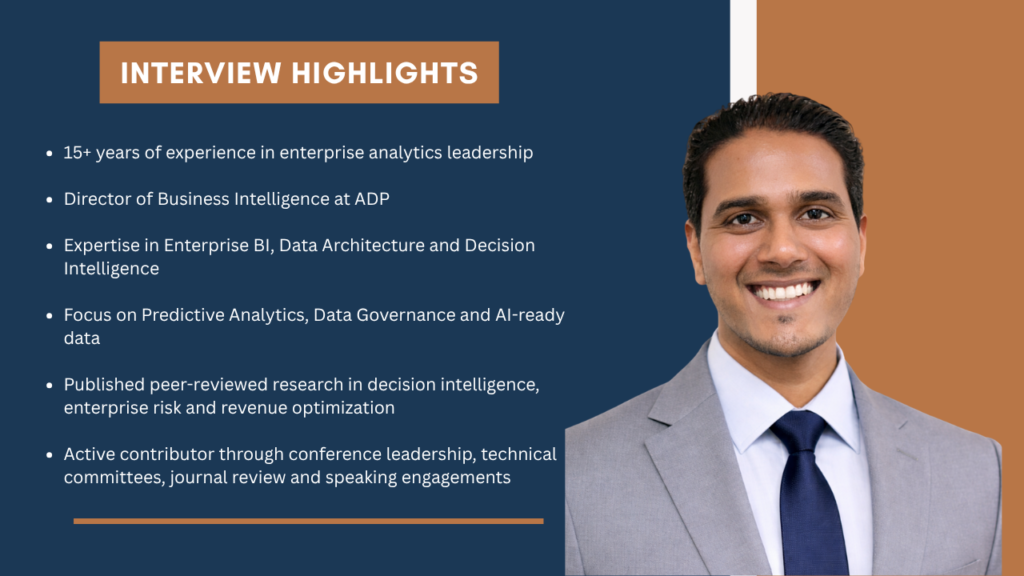
Janardhana Naidu Kola, Director of Business Intelligence at ADP, brings 15+ years of experience across business intelligence, analytics, data architecture, and decision-support systems. In this interview, he shares his perspective on transforming enterprise data into trusted, actionable insights—and the growing role of AI in business decision-making.
In an era where organizations have more data than ever, the real competitive advantage lies in turning that information into trusted, actionable intelligence. Janardhana Naidu Kola, Director of Business Intelligence at ADP, brings more than 15 years of experience across enterprise business intelligence, financial analytics, data architecture, predictive analytics, and decision-support systems.
In this conversation with The BizTech Bytes, Kola discusses his professional journey, the evolution of enterprise analytics, the role of AI, data governance, decision intelligence, and what organizations need to build truly AI-ready foundations.
AI can transform how people interact with enterprise information—but the quality of that intelligence still depends on the foundations underneath it.
1. Please introduce yourself and share your professional background, current role, and years of experience.
Janardhana Naidu Kola: I am Janardhana Naidu Kola, a technology and analytics leader with more than 15 years of experience in enterprise business intelligence, financial analytics, data architecture, predictive analytics, and decision-support systems. I currently serve as Director of Business Intelligence at ADP, where I lead analytics initiatives supporting sales strategy, forecasting, performance measurement, client retention, and executive decision-making.
My career began in technical roles involving software, data, and analytics and gradually evolved into designing enterprise-scale analytical capabilities and leading BIstrategy.
Beyond my industry role, I am also actively involved in research, peer review, conference speaking, and professional service. I value this combination because it allows me to connect real enterprise challenges with developments taking place across the broader research and technology community.
2. What inspired you to pursue your career, and how has your professional journey evolved over time?
Janardhana Naidu Kola: I have always been interested in how technology can transform complex information into something useful. Early in my career, I was focused primarily on building applications, data solutions, reports, and analytical systems. As I gained experience, I became more interested in the decisions behind those systems: who needs the information, what problem they are trying to solve, and whether the analysis actually changes an outcome.
That perspective changed the direction of my career. I moved from primarily developing technical solutions to designing analytics capabilities around business problems and eventually into BIleadership.
At the same time, I continued my academic and professional development through graduate study spanning technology and business, along with research, publishing, peer review, and engagement with technical communities. That combination of technical foundation, business understanding, and continuous learning has shaped how I approach problems today.
3. What are your key areas of expertise, specialization, and industry focus?
Janardhana Naidu Kola: My primary areas of expertise are enterprise business intelligence, financial and sales analytics, enterprise data architecture, predictive risk analytics, and decision intelligence.
Much of my industry experience has involved complex environments across human capital management, payroll, employee benefits, sales, and financial analytics, where information is often distributed across CRMplatforms, operational applications, financial systems, and other enterprise data sources.
A recurring focus of my work is connecting these fragmented sources into trusted analytical capabilities that help leaders understand performance, identify risk, and make better decisions.
My research interests extend these areas into topics such as enterprise analytics frameworks, AI-enabled decision systems, data governance, predictive modeling, and the evolving relationship between business intelligence and artificial intelligence.
Alongside my industry work, I have published peer-reviewed research in these areas and contribute to the broader research community through manuscript review, conference speaking, and professional service.
4. Can you share a significant achievement, project, research contribution, publication, or innovation that you are particularly proud of?
Janardhana Naidu Kola: One initiative I am particularly proud of involved developing an analytics and revenue-attribution capability for a broker referralprogram. When the program began, there was no complete analytical infrastructure connecting referrals with downstream business outcomes.
I developed an approach that connected different stages of that journey, from referral origination through business activation and revenue-related outcomes. The objective was not simply to produce another dashboard, but to create a consistent analytical framework through which stakeholders could understand where business originated, how it progressed, and how outcomes could be measured.
What started as a single reporting capability grew into a framework used across multiple stakeholder groups as the program scaled, and it remains part of ongoing business decision support today.
What I value most about the project is that it represents the intersection I find most interesting: identifying a real business problem, designing the underlying data and analytical approach, and turning it into a sustainable decision-making capability.
5. What challenges have you faced in your career, and what lessons did you learn from overcoming them?
Janardhana Naidu Kola: One of the most persistent challenges I have encountered is fragmentation. Large organizations often have multiple systems, data sources, business processes, and definitions for what appears to be the same question. Integrating the technology is only part of the challenge; establishing a shared understanding of what the data means can be equally difficult.
That taught me that successful analytics requires more than technical expertise. You have to understand the business process, listen to the people closest to it, challenge assumptions, establish consistent definitions, and build trust in the information.
I have also learned not to confuse delivery with impact. Completing a dashboard, model, or data product is not necessarily success. The more important question is whether people use it and whether it improves a decision, reduces uncertainty, identifies risk, saves time, or creates measurable businessvalue.
6. What emerging technologies, trends, or developments do you believe will shape the future of your industry?
Janardhana Naidu Kola: Artificial intelligence will clearly have a major impact, but I believe one of the most important changes will be how people interact with enterprise information.
Traditional business intelligence often requires users to navigate multiple dashboards, reports, filters, and applications to find an answer. AI creates the possibility of a more natural interaction, where a user can express a business question and receive contextual intelligence drawn from multiple underlying systems.
That said, AI cannot compensate for unreliable data, inconsistent definitions, weak governance, or poor architecture -in many cases, introducing AI just makes those foundational issues harder to ignore. The technologies I’m watching most closely are less about new AI capability and more about whether organizations can pair that capability with the data discipline it depends on.
7. What skills, knowledge, or qualities do you consider most important for success in today’s professional landscape?
Janardhana Naidu Kola: I believe one of the most important abilities today is connecting technical knowledge with business understanding. Professionals need enough technical depth to understand data, architecture, analytics, and AI, but they also need to understand the business process and the decision that the technology is intended to improve.
Communication is equally important. A technically sophisticated analysis has limited impact if it cannot be explained clearly to the person who needs to act on it.
I would also emphasize curiosity, adaptability, and critical thinking. Technologies will continue to change rapidly. Rather than trying to chase every new tool, I believe it is more valuable to develop strong fundamentals, understand underlying concepts, ask good questions, and maintain the discipline to continue learning throughout your career.
8. Who or what has influenced your professional growth, and what motivates you to continue learning and innovating?
Janardhana Naidu Kola: My professional growth has been shaped less by any single mentor and more by a pattern: sitting across the table from a business leader who couldn’t get a straight answer out of the systems they already had, and having to figure out why. Those moments taught me to look past what a system can technically do and focus on what someone actually needs to make a decision.
Peer review has had a similar effect from a different angle. Reviewing other people’s research forces me to evaluate assumptions and methodology critically, which sharpens how I evaluate my own work. Speaking at conferences does the reverse — it exposes my thinking to practitioners and researchers working on different problems, which keeps me from assuming my own environment is representative of the industry.
What motivates me is that there is always another difficult business question to solve, and the challenges around data quality, governance, adoption, and responsible AI continue to evolve along with the technology.
9. What advice would you give to students, young professionals, researchers, or aspiring entrepreneurs?
Janardhana Naidu Kola: My first advice would be to build strong fundamentals before chasing trends. Technologies, programming languages, platforms, and AI tools will continue to change, but the ability to understand a problem, work with data, think critically, communicate clearly, and continuously learn will remain valuable.
Second, become curious about the business behind the technology. Do not only ask, “What should I build?” Ask, “What problem are we solving? Who makes the decision? What information do they need? And how will we know whether our work actually helped?”
I would also encourage young professionals to learn beyond the boundaries of their job description. Research, writing, speaking, mentoring, reviewing the work of others, and participating in professional communities can expose you to perspectives you may never encounter within a single organization.
Most importantly, do not be afraid of difficult problems. Some of the greatest professionalgrowth comes from situations where the answer is not obvious and you have to learn, experiment, collaborate, and improve your approach over time.
10. What is your vision, mission, future goals, and the impact you hope to create through your work?
Janardhana Naidu Kola: My long-term vision is to help organizations close the gap between having data and being able to act on it. Most enterprises have spent decades getting better at collectinginformation; the harder problem now is making it understandable and trustworthy enough to actually change a decision.
I want my work — across my role at ADP and through research, writing, and professional service — to sit at the intersection of enterprise data architecture, BI, predictive analytics, and AI, with governance and human judgment built in rather than bolted on afterward.
If the practical outcome of that work is that more organizations treat analytics as a decision-making capability rather than a reporting exercise, that’s the impact I’m aiming for.
KEY INSIGHTS
01
Build the foundation first
AI is only as reliable as the data and architecture supporting it.
02
Focus on decisions, not dashboards
Analytics should help people make better decisions.
03
Connect technology with business
Technical expertise becomes more valuable when combined with business understanding.
04
Trust matters
Governance, consistency and transparency are essential for enterprise intelligence.
05
Keep learning
Curiosity, adaptability and strong fundamentals remain critical as technology evolves.
Janardhana Naidu Kola is Director of Business Intelligence at ADP, with 15+ years of experience in enterprise analytics, data governance, decision intelligence, and AI-ready data strategy. He has led enterprise analytics and executive decision-support initiatives, published peer-reviewed research on decision intelligence, enterprise risk, and revenue optimization, and received international recognition for his work. An active contributor to the global technology community, he participates in conferences, technical committees, journal reviews, judging, and invited speaking engagements. He holds three master’s degrees spanning computer science, business, and organizational management.