From Software Engineering to AI-Native Architecture: An Expert Perspective with Navneet Kumar Tyagi on the Future of Enterprise Technology
From cloud modernization to AI-native architecture, technology is moving toward intelligent ecosystems where AI agents, APIs, data, cloud platforms, edge computing, and people work together.
In our latest Expert Interview, a technology leader with 19+ years of experience shares perspectives on AI-native architecture, enterprise modernization, responsible AI, continuous learning, and building technology that creates meaningful real-world capability.
Most organizations still treat AI as a feature added to existing software. Navneet, a Senior Software Engineer and Cloud/AI Architect at Finance of America, argues that this is the wrong starting point. His work spans mortgage, energy and healthcare, industries where technology has to be scalable as well as secure, resilient, auditable and aligned with regulation.
In this conversation with The BizTech Bytes, he explains what he calls “AI-native architecture,” why technical excellence alone is not enough to succeed in enterprise technology, and why questions of trust and governance are becoming as central to system design as questions of scale.
“I am particularly interested in what I call AI-native architecture—designing systems where intelligence is considered part of the architecture rather than simply added as a feature afterward.” — Navneet
THE CONVERSATION
1. Please introduce yourself, including your professional background and current role.
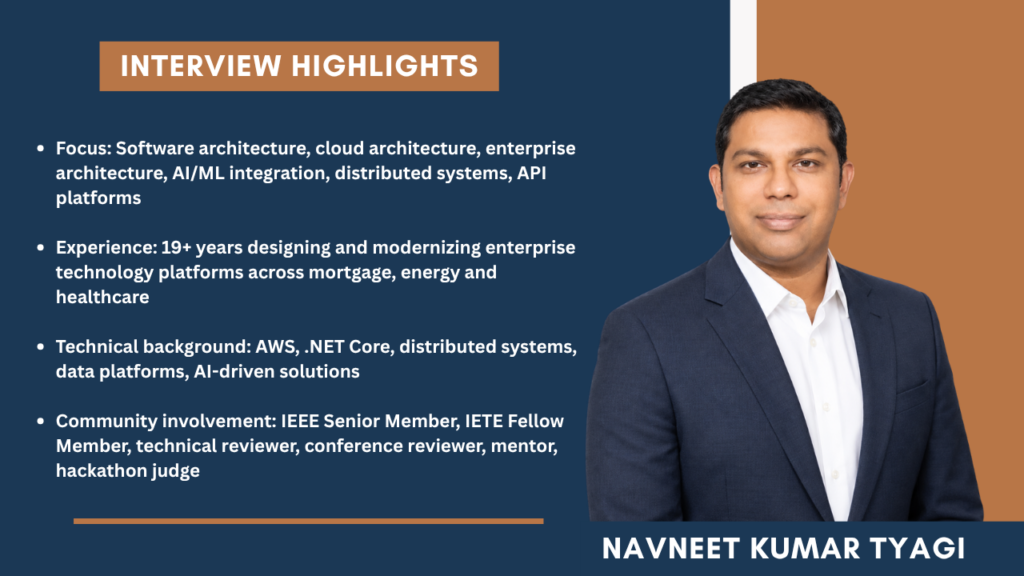
Navneet: I am a Senior Software Engineer and Cloud/AI Architect with more than 19 years of experience designing and modernizing enterprise technology platforms across the mortgage, energy, and healthcare industries. My work sits at the intersection of software engineering, cloud architecture, artificial intelligence, and enterprise transformation. Currently, I work as a Senior Software Engineer at Finance of America, where I focus on scalable cloud-based platforms, API architectures, automation, and technology modernization. Over the years, I have worked extensively with AWS, .NET Core, distributed systems, data platforms, and AI-driven solutions. Beyond my professional role, I actively contribute to the technology community as an IEEE Senior Member, IETE Fellow Member, technical reviewer, conference reviewer, mentor, and hackathon judge. I enjoy sharing practical perspectives on cloud, AI, enterprise architecture, and emerging technologies.
2. What inspired your career path, and how has your journey evolved?
Navneet: My career began with a strong interest in software engineering and solving complex technical problems. Early in my career, I was primarily focused on building reliable applications and learning how software systems work at scale. As technology evolved, I realized that solving larger problems required looking beyond individual applications. I became increasingly interested in architecture—how applications, APIs, data, cloud infrastructure, security, and business processes come together to create an entire technology ecosystem. That led me from software development toward cloud architecture, enterprise modernization, and eventually AI-enabled systems. Today, I am particularly interested in what I call AI-native architecture—designing systems where intelligence is considered part of the architecture rather than simply added as a feature afterward. My journey has therefore evolved from writing software, to designing systems, to thinking about how technology can fundamentally transform businesses.
“Successful architecture requires communication, collaboration, business understanding, security awareness, and the ability to explain complex ideas to different audiences.”
3. What are your key areas of expertise and industry focus?
Navneet: My primary areas of expertise include software architecture, cloud architecture, enterprise architecture, AI/ML integration, distributed systems, API platforms, .NET technologies, AWS, data platforms, and enterprise modernization. From an industry perspective, I have worked across mortgage and lending, energy, and healthcare. These industries have been particularly valuable because they require technology that is not only scalable but also secure, resilient, auditable, and aligned with regulatory and business requirements. Recently, my focus has increasingly expanded toward AI-native architectures, generative AI, intelligent automation, multi-agent systems, cloud-native platforms, and the intersection of AI with enterprise architecture. I am especially interested in the question of how organizations can move from experimenting with AI to building trusted, scalable, production-grade AI systems.
4. Please share a significant achievement or project you are particularly proud of.
Navneet: One area I am particularly proud of is my work on large-scale modernization and automation initiatives where complex legacy processes were transformed into scalable cloud and API-based platforms. Working in domains such as mortgage and lending has taught me that modernization is rarely just about replacing old technology. It involves understanding business processes, data dependencies, security requirements, integration challenges, and the people who ultimately use the systems. I have had the opportunity to evaluate and launch technology products that reached millions of people, while also working on high-scale AWS and .NET Core platforms and AI-driven automation. What makes these achievements meaningful to me is not simply the technology involved. It is seeing architecture translate into measurable business capability—faster processes, better scalability, improved automation, and better experiences for customers and employees.
5. What challenges have you faced in your career, and what lessons did you learn?
Navneet: One of the biggest challenges has been continuously reinventing myself as technology changes. The skills that made someone successful in one technology generation do not automatically translate into the next. I have worked through major transitions from traditional application development to service-oriented architectures, cloud computing, distributed systems, and now AI. A major lesson I have learned is that continuous learning is not optional in technology—it is part of the job. I have also learned that technical excellence alone is not enough. Successful architecture requires communication, collaboration, business understanding, security awareness, and the ability to explain complex ideas to different audiences. Most importantly, I have learned to focus on fundamentals. Technologies change rapidly, but principles such as scalability, reliability, security, simplicity, maintainability, and customer value remain relevant.
“Innovation does not happen in isolation. It comes from combining ideas from different technologies, industries, research communities, and people.”
6. Which emerging technologies or trends will shape the future of your industry?
Navneet: I believe several technologies will have a major impact. First, AI-native application architecture will become increasingly important. Rather than treating AI as an isolated feature, organizations will design applications around intelligent agents, contextual data, orchestration, and human-AI collaboration. Second, generative AI and multi-agent systems will change how enterprise processes are automated. The important shift will be from AI that simply generates content to AI that can reason across enterprise workflows while operating within appropriate controls. Third, cloud and edge computing will increasingly converge. Distributed intelligence will allow organizations to process information closer to where it is generated while using the cloud for large-scale training, coordination, and analytics. Finally, I expect AI governance, security, and responsible AI architecture to become core architectural disciplines. Organizations will need to answer not only “Can we build this?” but also “Can we trust it, secure it, monitor it, explain it, and operate it responsibly?”
7. What qualities are most important for success in today’s professional landscape?
Navneet:Adaptability is probably the most important quality. Technology professionals need to be comfortable learning new technologies while also understanding which problems those technologies actually solve. Being able to use a tool is different from understanding when and why to use it. Curiosity is equally important. The best architects and engineers I have worked with continuously ask questions, challenge assumptions, and explore alternatives. I would also emphasize communication. As technology becomes more complex, the ability to translate technical concepts into business outcomes becomes increasingly valuable. Finally, I believe integrity, collaboration, and ownership matter enormously. Technology is increasingly influential in people’s lives and businesses, so professionals need to think about security, reliability, ethics, and long-term consequences—not just whether something can be built.
8. What has influenced your growth and motivates you to continue innovating?
Navneet: My biggest motivation has always been solving problems that are difficult enough to require new thinking. I enjoy the process of taking a complex problem, understanding the underlying constraints, and designing a simpler and more scalable solution. My involvement in the broader technology community has also influenced me significantly. Reviewing research papers, judging hackathons, mentoring innovators, participating in professional organizations, and interacting with other technology leaders expose me to ideas outside my day-to-day responsibilities. These experiences reinforce an important principle for me: innovation does not happen in isolation. It comes from combining ideas from different technologies, industries, research communities, and people. I am motivated by the opportunity to keep learning while contributing knowledge back to the community.
9. What advice would you give to students, researchers, or aspiring entrepreneurs?
Navneet: I would encourage them to build rather than only consume. Learn the fundamentals, but also create real projects. A working prototype can teach you things that a course or tutorial cannot. I would also recommend developing a combination of depth and breadth. Become genuinely strong in one or two technical areas while understanding adjacent areas such as cloud, data, security, AI, and business. For researchers, I would encourage focusing on problems that have practical relevance. For entrepreneurs, understand the problem before becoming attached to a particular technology. And for everyone entering technology, develop the habit of continuously learning. You do not need to know everything. You need to know how to learn, how to evaluate information, and how to turn what you learn into something useful.
10. What is your professional vision and the impact you hope to create?
Navneet: My professional vision is to help build the next generation of intelligent, secure, scalable, and human-centered enterprise systems. I see the future of enterprise technology moving beyond traditional applications toward ecosystems where cloud platforms, AI agents, APIs, data, edge computing, and humans work together as an integrated system. I want my work to contribute to that transition in a practical way—particularly in highly regulated and complex industries where reliability, security, and trust are just as important as innovation. Ultimately, I hope to create technology that does more than demonstrate technical sophistication. I want it to solve meaningful problems, improve how organizations operate, and create better experiences for the people who depend on those systems. For me, the most meaningful measure of innovation is not how new the technology is, but how much positive capability it creates when it reaches the real world.
Key Takeaways
AI-native architecture treats intelligence as core to system design, not a feature added afterward.
Enterprise modernization depends on understanding business processes, data dependencies, security and end users, not just replacing old technology.
Multi-agent systems are shifting enterprise automation from content generation to reasoning across workflows, within appropriate controls.
AI governance, security and explainability are becoming core architectural disciplines, alongside scalability and performance.
Technical skill alone doesn’t sustain a career; communication, adaptability and continuous learning matter as technology generations shift.
Advice for newcomers: build real projects, develop depth in one or two areas alongside broader technical fluency, and focus on problems with practical relevance.
Somya Agrawal
Somya Agrawal works with BizTech Bytes as an Author and Interview Contributor, creating engaging content on technology, business, startups, and digital transformation. She also supports founder and expert interviews, helping showcase innovative ideas, industry perspectives, and emerging trends for a global audience.
Senior Software Engineer and Cloud/AI Architect at Finance of America
Navneet Kumar Tyagi is a Senior Software Engineer and Solution Architect with nearly two decades of experience architecting enterprise technology solutions across the mortgage, healthcare, and energy sectors. His work spans AI-native systems, cloud modernization, enterprise architecture, distributed platforms, API engineering, and intelligent automation. An IEEE Senior Member and IETE Fellow Member, Navneet actively contributes to the global technology community through research review, technical publications, hackathon judging, mentoring, and speaking engagements. His thought leadership explores how organizations can responsibly integrate AI, cloud, and modern architecture to create secure, scalable, resilient, and future-ready digital enterprises.