
Protected: Can a Large Language Model Learn From Medical Clinical Notes Without Remembering Them?

There is no excerpt because this is a protected post.
Beyond Speed: How Microsoft Power Platform Is Redefining Enterprise DevOps
Low-Code and No-Code platforms are often perceived as productivity shortcuts for building applications quickly. In modern enterprises, however, their strategic value extends far beyond speed. When implemented with proper governance, security, and DevOps discipline, these platforms become a foundational layer for digital transformation.
AI-Assisted Development: Using Copilot to Elevate M365 Engineering Practices
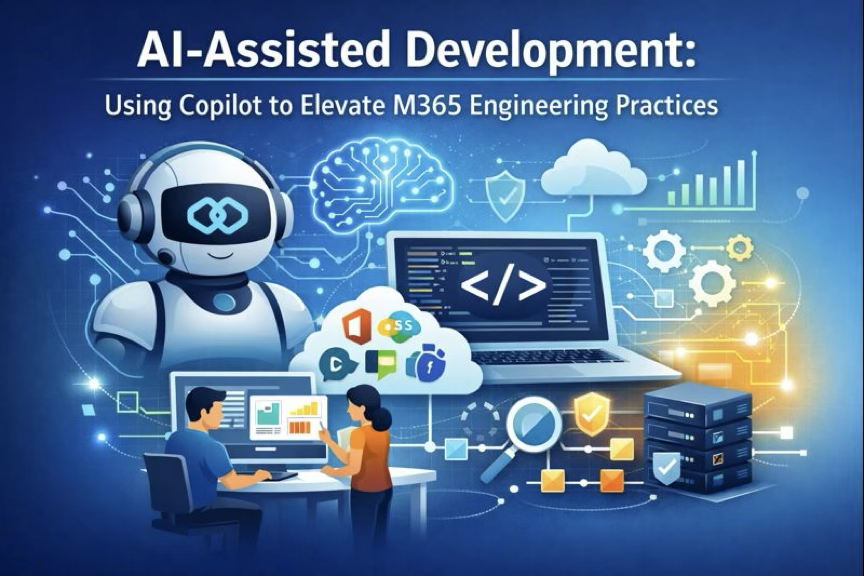
Artificial intelligence is rapidly changing how software is written, tested, and maintained—but not always in the ways developers initially expect. While many discussions around AI focus on speed and automation, engineering teams still face a critical question: Can AI improve code quality, maintainability, and delivery discipline—not just output volume?
Intelligent Finance Meets Intelligent Infrastructure:Practical Innovations Shaping Modern Financial Services

From Rule-Based Finance to Adaptive Intelligence Traditional financial systems were designed around static rules, periodic reporting, and retrospective analysis. While effective in stable conditions, these approaches are increasingly misaligned with today’s real-time, high-volume digital economy. Modern financial platforms now rely on adaptive intelligence—systems that learn continuously from data, detect emerging risks, and support decisions as […]
LLMs at the Edge: Decentralized Power and Control

First, large language models (LLMs), such as those in the recent GPT-3, have proved crucial in processing and generating natural language and are core in applications like translation, chatbots, and content generation. Nonetheless, LLMs depend on centralized cloud infrastructure, which has drawbacks. Clients of these models demand significant computational power and storage, making real-time response a potential issue and privacy concern as the data is sent to distant servers.
Data Sovereignty: Designing AI for Local Control

Data in the contemporary world is one of the most valuable assets in the demanding technologies, markets, and society. However, the question of how to govern and control the constantly increasing amount of data in the world also arises. Data sovereignty, therefore, means that the local governments or organizations have the right to decide on the use of data collected in a given geographical area they control.
Agentic AI in Healthcare: From Assistance to Autonomy

Healthcare is one of the most data-rich and complex industries in the world. With electronic health
records (EHRs), medical imaging, genomics, wearable devices, and clinical trial data, the
challenge lies not in scarcity of information but in making sense of it at scale. Traditional AI
systems have shown promise in diagnostics, drug discovery, and patient management, but they
largely function as reactive systems providing outputs only when prompted.
Implementing Privileged Access Management Solutions: Challenges and Best Practices

Privileged Access Management (PAM) is a critical component in securing privileged accounts, credentials, and secrets in enterprise environments. This article delves into the implementation of PAM solutions, outlining the challenges encountered and the best practices to overcome them. It serves as a comprehensive guide for organizations aiming to bolster their cybersecurity posture through effective PAM strategies.
Operational Lessons from Running High-Availability Java Systems

High availability Java systems sit quietly behind many of the services people depend on everyday. Financial platforms, communications systems, and regulated enterprise applications all rely on Java services that are expected to stay up, stay consistent, and fail gracefully when
something goes wrong. On paper, these systems are designed with redundancy, failover, and monitoring in mind. In production, the reality is messier.
The Execution Gap in AI: Why Strategy Isn’t Translating Into Real Impact

AI is everywhere in strategy decks, leadership discussions, and boardroom priorities. Yet, despite massive investment and interest, many organizations are struggling to turn AI plans into real, measurable outcomes. This disconnect is what defines the Execution Gap in AI—the growing difference between knowing what AI can do and actually making it work at scale. What Is the […]