Introduction
Healthcare technology is undergoing rapid transformation. The demand for real-time data access, secure interoperability, and scalable cloud deployments has pushed healthcare platforms to integrate electronic health records (EHRs), clinical decision systems, patient engagement tools, and analytics engines—often within the same ecosystem.
At the center of this transformation lies Artificial Intelligence (AI). While AI is widely recognized for its impact on diagnostics and clinical workflows, its influence on quality assurance (QA) is equally profound.
Highlighted Insight: Testing is no longer a downstream activity—it is a continuous, intelligent process woven into every stage of software delivery.
Traditional automation frameworks, built on static scripts and predefined flows, struggle to survive in today’s dynamic environments. The result is brittle test suites, delayed feedback loops, and an increased risk of defects entering production—an unacceptable outcome in healthcare systems.
“In modern healthcare platforms, quality assurance is no longer a final checkpoint—it is a continuously evolving intelligence embedded into the delivery lifecycle.”
The Challenge of Modern Healthcare QA
Cloud-native healthcare systems introduce complexity at multiple levels:
- Microservices and distributed architectures, increasing integration points
- Strict regulatory compliance, including HIPAA, FHIR, and SMART on FHIR
- Highly heterogeneous data, spanning clinical, operational, telemetry, and behavioral signals
- Accelerated CI/CD pipelines, demanding continuous validation without slowing delivery
“Static test automation cannot keep pace with systems that evolve by the hour.”
The next frontier is intelligent automation—where systems understand context, learn from behavior, and dynamically decide what to test, when to test, and how to test.
AI-Driven Test Orchestration: A New Paradigm
AI-empowered test orchestration shifts AI from being merely a system under test to becoming an active participant in quality engineering.
1. Context-Aware Test Planning
Instead of executing full regression suites for every release, AI models analyze:
- Code changes and commit history
- Build artifacts
- Runtime telemetry and historical defects
This enables the orchestration layer to identify high-risk impact zones and prioritize tests accordingly.
Highlighted Benefit: Faster feedback, reduced execution time, and earlier detection of critical failures.
2. Multi-Agent AI Frameworks
Unlike traditional linear test execution, AI-driven orchestration leverages multi-agent systems, where each agent specializes in a domain such as:
- API validation
- Security and compliance checks
- Performance profiling
- User-journey simulation
These agents can communicate, share findings, reprioritize tasks, and adapt execution paths in real time.
“Testing evolves from scripted execution into collaborative intelligence.”
Traditional QA vs AI-Empowered Orchestration
| Area | Traditional QA Automation | AI-Empowered Test Orchestration |
|---|---|---|
| Test Selection | Static regression suites | Context-aware, risk-based |
| Execution Style | Script-driven | Multi-agent AI-driven |
| Adaptability | Low | High |
| Maintenance | High manual effort | Self-healing automation |
| Feedback Speed | Slow | Near real-time |
| Defect Handling | Reactive | Predictive |
| Scalability | Limited | Cloud-native scalable |
| Healthcare Compliance | Manual validation | Policy-aware automated checks |
Applied Case: Cloud-Native Healthcare Pipeline
Consider a real-world healthcare platform consisting of:
- Data ingestion APIs
- Clinical decision workflows
- Identity and access management
- Analytics and reporting dashboards
An AI test orchestrator can:
- Review recent commits and change logs
- Map changes to affected microservices
- Assign risk scores
- Execute targeted test suites
- Generate exploratory tests using generative AI to simulate real clinical and patient behavior
Highlighted Outcome: Reduced production downtime and improved reliability of patient-critical systems.
Observability, Feedback, and Continuous Learning
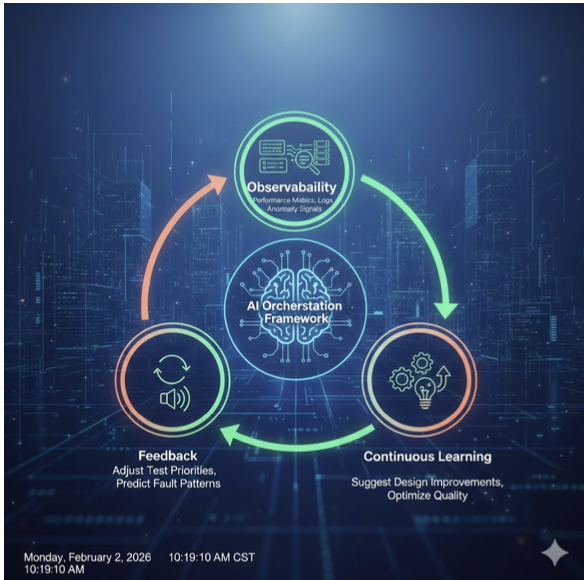
AI-driven orchestration thrives when tightly integrated with observability platforms. By continuously ingesting logs, metrics, traces, and anomaly signals, the system can:
- Adjust future test priorities
- Predict long-term fault patterns
- Recommend architectural or design improvements
This creates a closed-loop learning system, where quality continuously improves as the platform evolves.
“Quality becomes a living system—learning, adapting, and improving with every release.”
Ethical and Compliance Considerations
In healthcare, intelligent automation must operate within strict ethical and regulatory boundaries:
- AI-generated tests must not expose or misuse patient data
- Orchestration policies must respect data residency and compliance mandates
- Human oversight remains essential for governance and trust
Embedding compliance rules directly into orchestration logic ensures innovation without compromising safety or audit readiness.
Conclusion
AI-empowered test orchestration is not about replacing testers—it is about augmenting human intelligence. For cloud-native healthcare systems, where reliability, compliance, and resilience are non-negotiable, this approach represents a fundamental shift in how quality is delivered.
Final Thought: Organizations that embrace intelligent test orchestration will lead the next generation of trustworthy, scalable, and resilient healthcare technology.
Rea the Full article here by- Baradwaj Bandi Sudakara
Staff Software Engineer| Program Manager | Tech Lead | Domain Expert | Java, Python, JavaScript | MongoDB | Cloud (AWS/GCP) | Graph QL| Test Automation | AI-Powered Development (Copilot, Gemini, Claude)

I am Baradwaj Bandi Sudakara, a Staff Software Engineer with over 15+ years of experience in AI-driven Quality Engineering, cloud-native automation, and intelligent test orchestration. I specialize in designing scalable automation frameworks for healthcare and enterprise platforms, combining modern AI techniques—such as multi-agent orchestration and context-aware automation—with cloud infrastructure to enhance software quality, resilience, and observability. I have published multiple technical articles and presented my work on global technology platforms.