
Joyjit Roy (Author)
AI/ML & Cloud Transformation Leader
Joyjit Roy is a senior technology and program management leader with over 21 years of experience delivering enterprise digital transformation, cloud modernization, and applied AI programs across insurance, financial services, and global eCommerce. He leads enterprise-scale modernization initiatives integrating machine learning, intelligent automation, and Agile delivery frameworks.
Artificial intelligence has advanced well beyond simple chatbots. Modern systems now address tasks ranging from code generation to managing complex business workflows. However, not all AI systems operate the same way. Some rely on a single agent to manage tasks, while others use multiple agents that collaborate as a team. Understanding this distinction is important, as choosing the wrong approach can lead to solutions that fail under complexity.
In enterprise environments, the difference between single-agent and multi-agent approaches becomes clear as systems move beyond prototypes. Early design choices, even those that seem minor, can significantly impact delivery timelines, operational risk, and long-term stability. At scale, these architectural decisions directly affect outcomes.
What Makes an AI Agent Actually Useful
An AI agent is more than a program that follows instructions. It acts as a digital worker, perceiving its environment, making decisions, and taking actions to achieve specific goals. The key distinction is autonomy: while a traditional program requires explicit instructions at each step, an agent determines the steps independently.
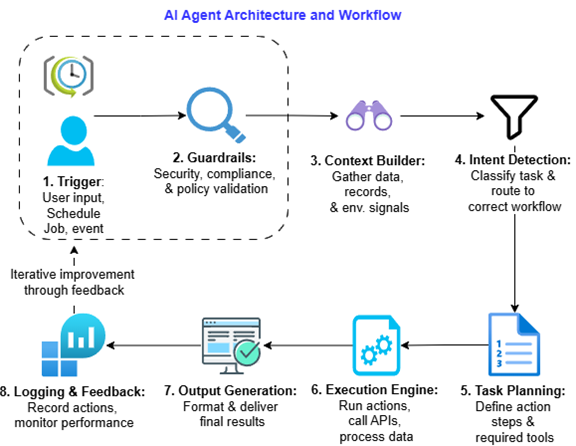
Figure 1: Single AI Agent Architecture
An effective agent requires four main abilities. It must perceive its environment through sensors or data inputs, reason about that information to decide on actions, execute those actions through outputs or controls, and learn from experience to improve over time. These capabilities enable agents to handle tasks with minimal supervision.
The diagram below illustrates a typical eight-step AI agent workflow. It begins with a trigger, such as user input or a scheduled job. The system then validates requests, gathers relevant data to build context, and routes tasks based on intent detection. The agent plans the required steps, executes actions through APIs and tools, generates the final output, and logs all activity for monitoring and improvement. Feedback loops within this process enable continuous learning.
When One Agent Is All You Need
Single-agent systems are most effective for well-defined problems with clear boundaries. For example, a customer service chatbot that handles return requests. It knows the return policy, can look up order details, and follows a straightforward process to issue refunds. There is no need for multiple specialists because the task is contained and the rules are established.
Single-agent systems offer simplicity: one decision-maker, one knowledge base, and a single reasoning process to troubleshoot. They are well suited for tasks such as scheduling appointments, filtering spam, or recommending products based on purchase history. Focused training and optimization enable the agent to excel at its specific function.
In narrowly scoped operational workflows within regulated environments. For example, in routine account or policy updates, a single agent can manage tasks predictably when rules and data inputs are stable. Introducing additional agents in these scenarios often increases coordination overhead without enhancing reliability or outcomes.
However, single agents face limitations with complex problems. For instance, planning a comprehensive marketing campaign requires expertise in brand strategy, content creation, data analysis, budget management, and team coordination. Expecting one agent to master all these areas is technically possible but impractical.
The Power of Many Agents Working Together
Multi-agent systems use a different approach entirely. Instead of one generalist trying to do everything, you have multiple specialists who each handle their own piece of the puzzle. Think about how a newsroom works. You have reporters gather information, editors refine stories, fact-checkers verify claims, and designers create visuals. Each expert contributes unique skills, resulting in outcomes that would not be possible individually.
AI multi-agent systems operate similarly. One agent may focus on data analysis, another on generating written content, and a third on managing user interactions. These agents communicate, share information, and coordinate to address complex problems. This structure reflects how humans divide and manage large tasks.
The main advantage appears when addressing complex problems with many components. In software development, for example, agents may write code, test for bugs, review security, optimize performance, and document processes. Each task requires distinct expertise. A team of specialized agents can manage these areas simultaneously, while a single agent would find it difficult to maintain proficiency across all domains.
How Multi-Agent Systems Actually Collaborate
Coordinating multiple agents to achieve effective collaboration is complex. Successful operation requires clear communication channels, standardized protocols for information sharing, and mechanisms for conflict resolution. Many implementations encounter challenges at these stages. The accompanying diagram demonstrates the operation of a multi-agent system in which agents share a common knowledge base and environment. Each agent perceives information from the environment, processes queries, and provides feedback. Communication channels interconnect all agents, while a collaborative strategy governs task assessment and allocation. Information is shared through a centralized knowledge base accessible and updatable by all agents.
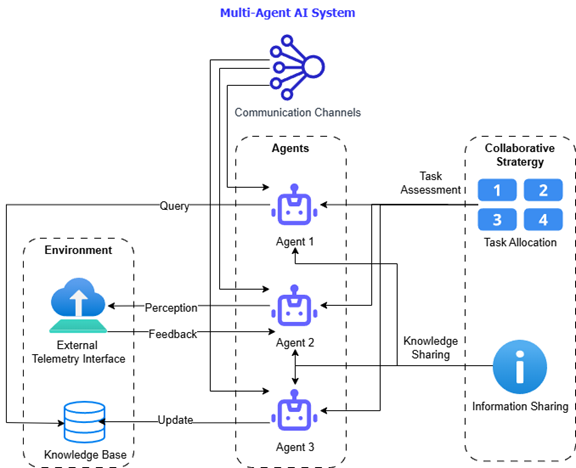
Figure 2: Multi-Agent Collaboration Model
Some systems use a coordinator agent that assigns tasks and manages the workflow. Others let agents negotiate directly with each other to figure out who does what. The coordination strategy you choose depends on the problem you are solving. A hierarchical structure with a manager agent works well when you have explicit task dependencies and need centralized control. Think of it like a project manager directing a team. On the other hand, peer-to-peer collaboration makes sense when agents need to adapt quickly to changing conditions without waiting for top-down decisions.
Picking the Right Approach for Your Problem
So, how to decide between single-agent and multi-agent systems? Start by looking at the complexity of your problem. If the task is straightforward with clear inputs and outputs, a single agent will probably serve you better. You will save time on development, avoid coordination headaches, and troubleshoot issues more easily.
Multi-agent systems make sense when you are dealing with problems that naturally break down into distinct subtasks requiring different expertise. They also shine when you need robustness because if one agent fails, others can often pick up the slack. The tradeoff is increased complexity in both design and operation. You need to carefully consider how agents will communicate, how you will handle conflicts, and how you will monitor overall system health.
Another factor to consider is scalability. Single-agent systems can hit performance limits when everything funnels through a single processing pipeline. Multi-agent systems can distribute the workload across multiple agents, making them better suited for handling large-scale operations. But that scalability comes with overhead in terms of coordination and communication between agents.
The future of AI likely involves both approaches working together. We will see single agents handling focused tasks within larger multi-agent frameworks. A customer support system might use a single agent for basic inquiries but bring in a team of specialized agents when dealing with complex technical issues that span multiple product areas. The key is matching the architecture to the problem rather than forcing every challenge into the same mold.
The most common mistake teams make is assuming that adding more agents automatically leads to better intelligence or outcomes. In practice, coordination cost, governance, and architectural discipline matter far more than agent count. Choosing the right approach requires understanding the problem boundaries first, not defaulting to the most complex solution available.




3 comments
This article provides a brilliant and clear breakdown of how specialized AI teams are transforming complex business workflows. It is an essential read for anyone looking to understand the future of scalable, autonomous technology!
Very Good 👍👍👍👍👍👍👍
Thank you @sumanta Kumar Roy.