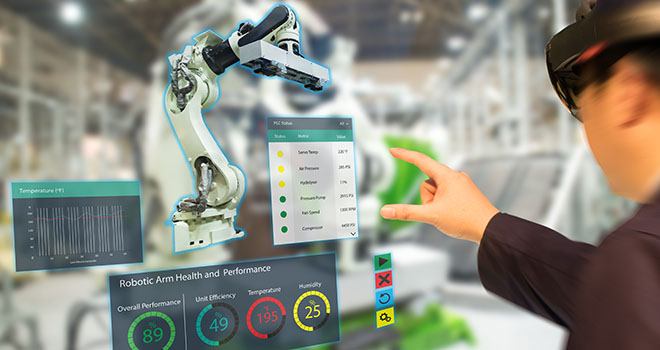
Spatial computing is rapidly evolving beyond consumer headsets as enterprises increasingly adopt augmented reality (AR) and mixed reality (MR) technologies for training, design, maintenance, and remote collaboration.
By seamlessly blending digital content with physical environments, spatial computing enables more intuitive interaction with data, machinery, and complex systems. This allows workers to visualize information in real time, overlay instructions on physical assets, and interact with digital models within real-world contexts.
Industries such as manufacturing, healthcare, construction, and aerospace are leveraging spatial tools to:
- Reduce operational errors through guided workflows
- Shorten training cycles using immersive simulations
- Improve situational awareness in high-risk or complex environments
- Enable remote expert assistance without physical travel
In manufacturing and infrastructure, spatial computing supports equipment maintenance and assembly by providing step-by-step visual guidance. In healthcare, it is being used for surgical planning, medical training, and enhanced diagnostics. Construction and aerospace sectors are applying spatial tools for design validation, site visualization, and precision planning.
As hardware becomes lighter, more wearable, and cost-effective, and as software platforms mature with better integration into enterprise systems, spatial computing is transitioning from experimental pilots to real-world deployment. Integration with AI, IoT, and digital twins is further expanding its enterprise value.
BizTech Foundation Insight:
Spatial computing represents a fundamental shift in how humans interact with digital systems. As physical and digital worlds converge, enterprises gain richer, more intuitive ways to visualize, understand, and act on information—unlocking new levels of productivity and decision-making.
🔍 Key Highlights
Technology: Spatial computing
Focus: Enterprise AR/MR applications
Impact: Enhanced productivity, faster training, improved decision-making


