
Beyond Speed: How Microsoft Power Platform Is Redefining Enterprise DevOps

Abstract

Low-Code and No-Code platforms are often perceived as productivity shortcuts for building applications quickly. In modern enterprises, however, their strategic value extends far beyond speed. When implemented with proper governance, security, and DevOps discipline, these platforms become a foundational layer for digital transformation. This article examines how Microsoft Power Platform, tightly integrated with Microsoft 365 and Azure, is reshaping enterprise DevOps practices by enabling scalable automation, governed innovation, and AI-assisted development.

Rethinking Low-Code in the Enterprise

Large organizations consistently face a widening gap between business demand and IT delivery capacity. Business units require rapid automation, streamlined approvals, and real-time insights, while development teams struggle with growing backlogs and legacy system maintenance.

Low-code platforms address this challenge by enabling faster solution delivery and closer collaboration between business stakeholders and IT. However, speed without structure introduces risk. Uncontrolled app growth, inconsistent data models, and security gaps can quickly undermine long-term value. In enterprise settings, low-code succeeds only when treated as an extension of the application lifecycle rather than a shortcut around it.

Power Platform as an Enterprise-Grade Framework

Microsoft Power Platform has evolved into a comprehensive application framework rather than a collection of isolated tools. Its native alignment with Microsoft 365, Azure, and enterprise identity services enables organizations to build solutions that meet corporate standards from day one.

  • Power Apps supports rapid application development while leveraging enterprise identity, role-based access control, and governed data sources such as Dataverse and SharePoint.
  • Power Automate replaces manual, email-driven processes with event-based workflows that improve reliability, traceability, and compliance.
  • Power BI transforms operational data into actionable intelligence, enabling both tactical decision-making and executive-level insights.

Together, these capabilities allow organizations to modernize legacy processes without compromising architectural integrity.

Aligning Low-Code with DevOps Practices

A common misconception is that low-code development conflicts with DevOps principles. In practice, enterprises increasingly apply CI/CD methodologies to Power Platform solutions. Environment separation, managed solutions, automated deployments, and source control integration using Azure DevOps or GitHub are now standard practices.

Governance and security are enforced through Microsoft Entra ID, data loss prevention policies, Conditional Access, and Microsoft Purview. This ensures that rapid development does not come at the cost of compliance or operational stability.

The Role of AI and Copilot

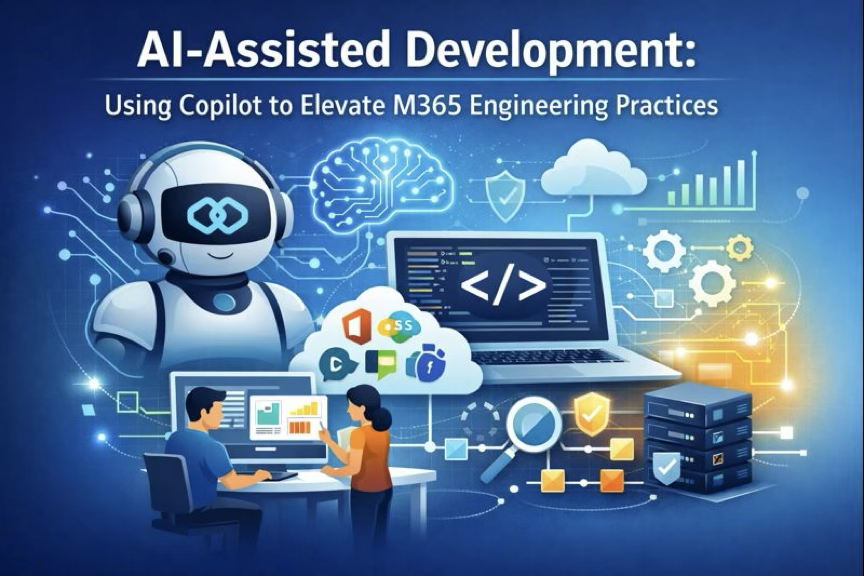
The introduction of Microsoft Copilot marks a significant shift in how low-code solutions are built and maintained. Copilot assists developers and makers with application logic, formulas, and workflow design, reducing time spent on repetitive tasks.

More importantly, AI enables professional developers and architects to focus on system design, optimization, and governance while empowering business users to contribute safely within defined boundaries. This collaboration model represents a new maturity phase for low-code adoption.

Real-World Enterprise Impact

Across industries, organizations are using Power Platform to modernize SharePoint-based systems, automate finance and HR workflows, manage external collaboration, and deliver near real-time dashboards to leadership teams.

The measurable benefits include reduced development timelines, lower operational costs, improved audit readiness, and greater transparency across business processes.

Challenges and Best Practices

Despite its advantages, Power Platform adoption is not without challenges. App sprawl, inconsistent standards, and unclear ownership can limit scalability. Successful organizations address these risks by establishing Centers of Excellence, defining architectural standards, and enforcing lifecycle management policies.

Training, governance, and continuous monitoring are essential to ensure that innovation remains sustainable.

Conclusion

Microsoft Power Platform demonstrates that low-code and no-code solutions can coexist with enterprise DevOps, security, and compliance requirements. When governed effectively, these platforms enable a collaborative development model that combines speed, control, and AI-driven assistance. The future of enterprise development lies not in replacing professional developers, but in augmenting them through well-structured low-code ecosystems.


Infomations

Time

Key Highlights

Trend

Enterprise Low-Code AI ecosystems and governed citizen development.

Focus

Microsoft Power Platform, AI-assisted development, enterprise DevOps, workflow automation, governance, and scalable digital transformation.

Impact

Accelerated application delivery, reduced operational overhead, stronger compliance, improved collaboration between IT and business teams, and scalable enterprise automation.

Author Profile

Sudheekar Pothireddy

Architect – AI & Digital Transformations (SharePoint, M365)

Sudheekar Reddy Pothireddy is a Senior SharePoint & Microsoft 365 Architect with over 15 years of experience delivering scalable, secure, and AI-driven enterprise solutions across SharePoint, M365, Power Platform, Azure, Copilot, and Nintex.

Related posts

Generative AI Is Changing How New Medicines Are Discovered

Generative AI Is Changing How New Medicines Are Discovered

Generative AI is beginning to change the way biomedical research is done, especially in the early stages…

AI in the Audio World: From Signal Processing to Perceptual Intelligence

AI in the Audio World: From Signal Processing to…

Audio has gone from being primarily a passive signal-processing problem to a smart, flexible system. AI has…

Building Next-Generation Intelligent Intrusion Prevention Systems

Building Next-Generation Intelligent Intrusion Prevention Systems

Table of Contents Introduction The convergence of traditional IDS/IPS technologies with AI-based systems will mark a major…

AI-Assisted Development: Using Copilot to Elevate M365 Engineering Practices

AI-Assisted Development: Using Copilot to Elevate M365 Engineering Practices

Artificial intelligence is rapidly changing how software is written, tested, and maintained—but not always in the ways…

Beyond Speed: How Microsoft Power Platform Is Redefining Enterprise DevOps

Beyond Speed: How Microsoft Power Platform Is Redefining Enterprise…

Abstract Low-Code and No-Code platforms are often perceived as productivity shortcuts for building applications quickly. In modern…

Intelligent Finance Meets Intelligent Infrastructure:Practical Innovations Shaping Modern Financial Services

Intelligent Finance Meets Intelligent Infrastructure:Practical Innovations Shaping Modern Financial…

From Rule-Based Finance to Adaptive Intelligence Traditional financial systems were designed around static rules, periodic reporting, and…

LLMs at the Edge: Decentralized Power and Control

LLMs at the Edge: Decentralized Power and Control

First, large language models (LLMs), such as those in the recent GPT-3, have proved crucial in processing…

Data Sovereignty: Designing AI for Local Control

Data Sovereignty: Designing AI for Local Control

Data in the contemporary world is one of the most valuable assets in the demanding technologies, markets,…

Agentic AI in Healthcare: From Assistance to Autonomy

Agentic AI in Healthcare: From Assistance to Autonomy

Healthcare is one of the most data-rich and complex industries in the world. With electronic health records…

Implementing Privileged Access Management Solutions: Challenges and Best Practices

Implementing Privileged Access Management Solutions: Challenges and Best Practices

Privileged Access Management (PAM) is a critical component in securing privileged accounts, credentials, and secrets in enterprise…

Operational Lessons from Running High-Availability Java Systems

Operational Lessons from Running High-Availability Java Systems

High availability Java systems sit quietly behind many of the services people depend on everyday. Financial platforms,…

Time to Value (TTV): The New KPI That Defines Product Success

Time to Value (TTV): The New KPI That Defines…

In today’s fast-moving digital landscape, traditional metrics like features, downloads, or even engagement are no longer enough.…

The “Latency Economy”: Why Speed Is Becoming the Ultimate Competitive Advantage

The “Latency Economy”: Why Speed Is Becoming the Ultimate…

A new competitive battleground is emerging in the digital world—latency. In an era defined by real-time applications,…

AI Misalignment Risk: When Intelligent Systems Don’t Align with Human Intent

AI Misalignment Risk: When Intelligent Systems Don’t Align with…

As artificial intelligence becomes more autonomous, a critical challenge is gaining attention: AI misalignment. This occurs when…

Predictive Interfaces: When Software Knows Before You Act

Predictive Interfaces: When Software Knows Before You Act

User interfaces are undergoing a quiet transformation. Instead of waiting for users to click, search, or type,…

The Execution Gap in AI: Why Strategy Isn’t Translating Into Real Impact

The Execution Gap in AI: Why Strategy Isn’t Translating…

AI is everywhere in strategy decks, leadership discussions, and boardroom priorities. Yet, despite massive investment and interest,…